The notes below are an ongoing record of ideas and observations that have come to me over time. They are often neither fully thought through nor implemented, though they may be in the future. Or they may not be—for some ideas, a note is sufficient. Some are dead ends, so there’s no point in developing them further. But even so, they may be worth recording.
2023-02-24: NEURAL FILTER GLITCHES
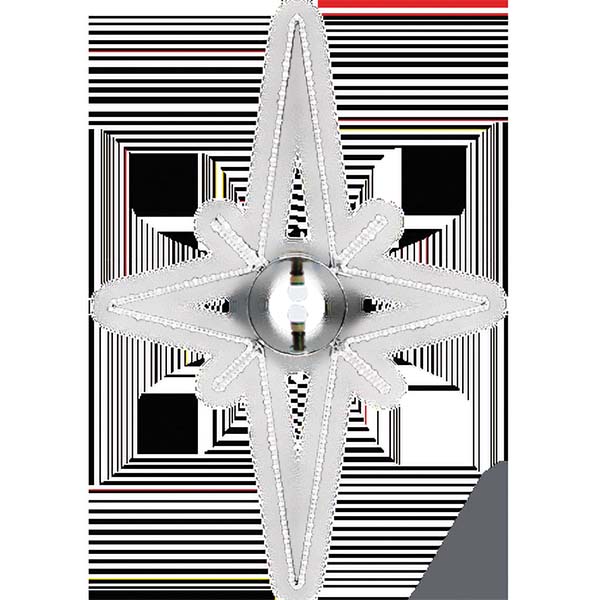
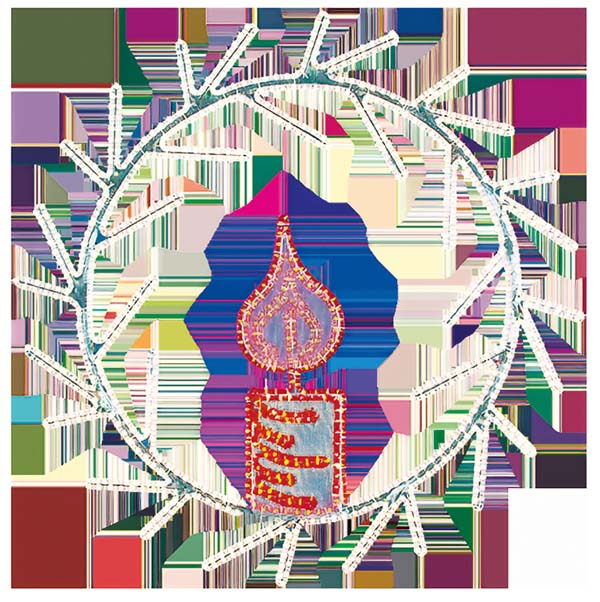
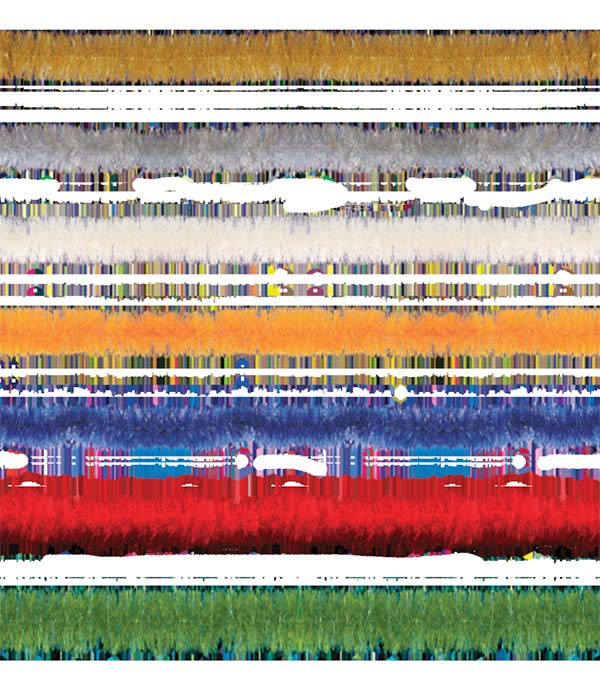
I discovered by chance while working that when I try to enlarge an image in Photoshop using Neural Filters—and that image is in the CMYK color profile and contains larger transparent areas—a strange, but usually quite aesthetic, glitch occurs.
Here is a sample of 3 out of 28 images I’ve recorded:
concepts-2023-02-24-neural-network-glitches-1.jpg
concepts-2023-02-24-neural-network-glitches-2.jpg
concepts-2023-02-24-neural-network-glitches-3.jpg
2023-10-04: GENETIC TRAJECTORIES
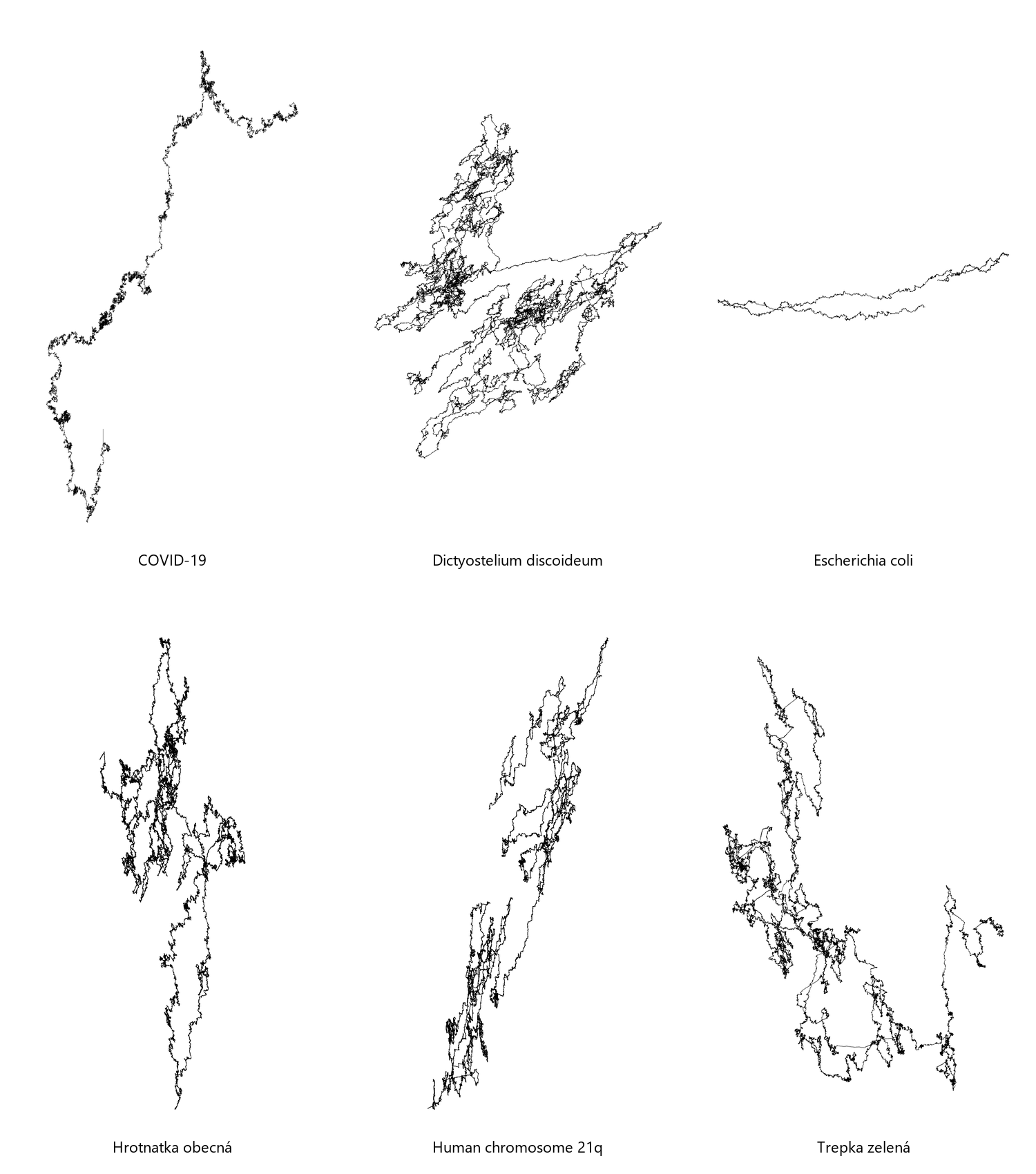
I converted genetic sequences into drawings using a simple rule: A means a step north, T/U means a step south, C means a step east, and G means a step west. The order of the bases thus determines the shape of a continuous line.
Resulting visualization: concepts-2023-10-04-genetic-trajectories.webp
Source code: concepts-2023-10-04-genetic-trajectories.py
2024-03-22: THE VISUAL RHYTHM OF WORKING ON A COMPUTER
I created a program that records every keystroke and mouse click while I work on the computer. Time progresses in the direction of normal typing, from left to right and top to bottom. A black dot indicates a recorded input; a white area indicates the absence of one.
Here is a sample of 3 out of 18 images I recorded:
concepts-2024-03-22-optical-rhythm-of-computer-work-1.png
concepts-2024-03-22-optical-rhythm-of-computer-work-2.png
concepts-2024-03-22-optical-rhythm-of-computer-work-3.png



Source code: concepts-2024-03-22-visual-rhythm-of-computer-work.py
2024-08-19: KUSHÍK’S POETRY
I was working on the computer, but my rat, Kushík, kept distracting me. He was climbing all over me, demanding attention, and running across my desk and over the computer. He started to frustrate me a little. So I got angry, opened a blank MS Word document for him, and told him something along the lines of, “Go ahead and be creative if you want to do it for me.”
So Kushík started running all over the keyboard.
This document was created: concepts-2024-08-19-kushikova-poetry.pdf
2024-12-05: THERMOZEPAM
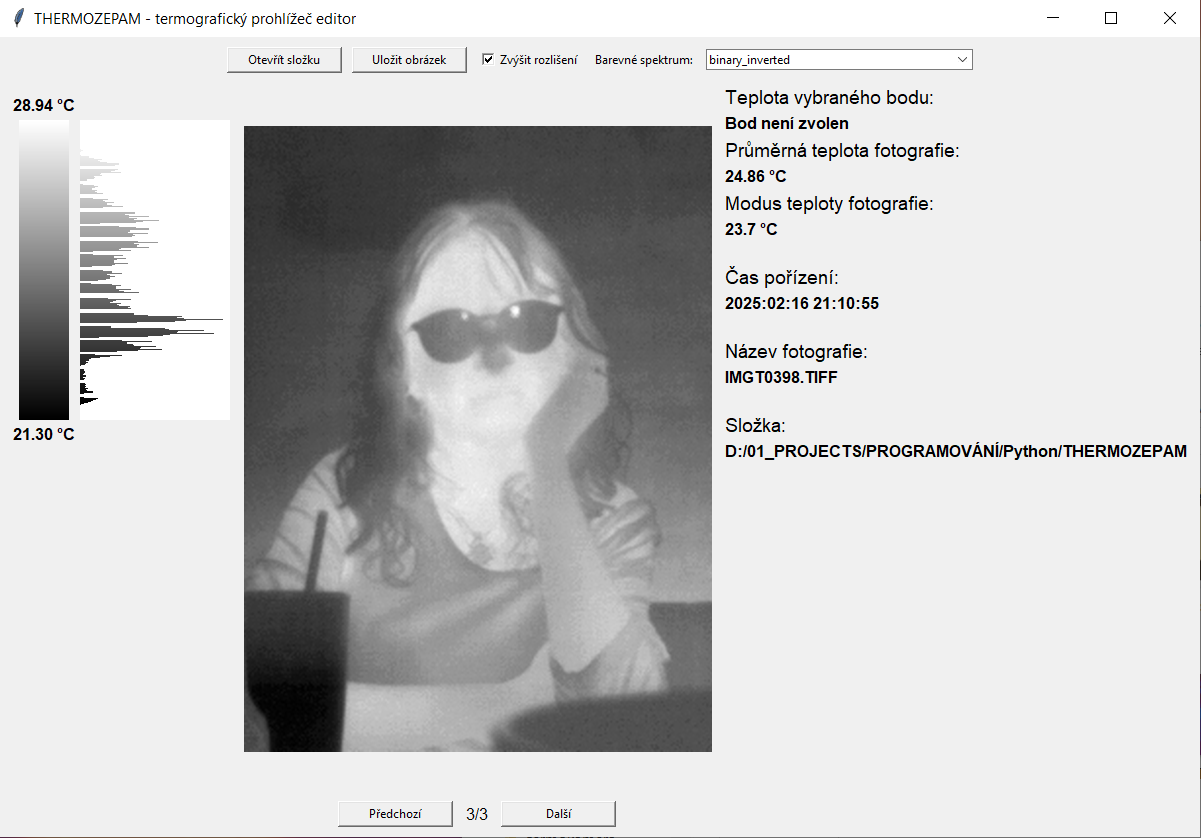
I created my own program for viewing and editing thermographic photos for my Seek Thermal RevealPRO thermal camera. I couldn’t find any suitable software for this camera on Windows, which is a shame, because its thermographic files contain temperature data that can be further processed.
I named the program Thermozepam because I’m satisfied with its design and find using it almost addictive. The program loads thermal TIFF files, allows you to change the image’s color map using colormaps from the matplotlib library, measure the average temperature of the image, determine the temperature mode, display the minimum and maximum temperatures, view a histogram, and—with a single click—display the temperature of a specific pixel. When saving, it can export a color-remapped PNG file and, optionally, enlarge it using interpolation.
Program screenshot: concepts-2024-11-10-thermozepam.png
Source code: concepts-2024-11-10-thermozepam.pyw
2025-12-05: A FLASH IN THE DARK
I had the idea to create an Arduino project in which I would place a laser inside an empty box (previously sterilized using a UV-C lamp). The laser would fire a one-second pulse at a random time (so that I wouldn’t know exactly when it happened, but would know with 100% certainty that it would happen within, say, 10 minutes). If I managed to do this correctly, no observer would perceive the light pulse.
2026-01-31: SIMULATION OF A PINHOLE CAMERA
I tried to create a simple, functional pinhole camera in Python. Back in high school, I’d already built a real physical one, but it seemed to me that if I simulated it, I’d better understand how it works—because it’s not enough to just punch a hole in a box, insert light-sensitive paper, develop it after exposure, and let physics do its job (however it works). Here, on the other hand, the physics must also be simulated.
I aimed to make the simulation as realistic as possible from an algorithmic standpoint, although my knowledge and the available computing power naturally remain limitations. For example, the program uses forward ray tracing—that is, tracing light from the source toward the scene and the camera—instead of the more common backward ray tracing, which traces rays from the camera back into the scene. The forward approach is closer to the physical direction of light propagation, but it tends to be very computationally inefficient.
Examples of program settings and explanations of parameters: concepts-2026-01-31-pinhole-simulation-settings.txt
Source code: concepts-2026-01-31-pinhole-simulation.py
2026-03-02: SORTING PHOTO PIXELS
I attempted to sort the pixels of photographs using an algorithm. The idea was to roughly sort the pixels by HUE and brightness: arranging pixels along one axis (e.g., x) by HUE and along the other axis (e.g., y) by brightness. This rearranges the photo’s pixels, but none disappear or are created. Nevertheless, the resulting photos lose their original meaning but retain their color atmosphere.
Source code: concepts-2026-03-02-photo-pixel-sorting.py
2026-04-13: RANDOM EXPLORATION OF THE INTERNET
For about two weeks, I devoted myself to randomly exploring the internet because I was curious to see what it looks like when it isn’t recommended by algorithms. I tried various approaches.
The first (naive) approach was to create a program to enter and open randomly generated URLs. This was, of course, extremely inefficient; the space of possible URLs is too large, and existing ones are sparsely represented.
The second approach was to build my own crawler and feed it some bizarre seed URL (such as the website kdomivolal.cz). I then tried to filter the results using an LLM and subsequently look only at the interesting ones (based on some defined criteria). I found a lot of bizarre things to amuse myself, but nothing groundbreaking.
The third approach was much more fruitful and entertaining. I discovered that Certstream exists. It’s a handy service that streams currently issued security certificates from around the world in real time. So it displays the URLs of websites that are either newly created or renewing their certificates.
Source code: concepts-2026-04-13-certstream-listener.py
I spent several days randomly clicking through these URLs. Most often, I came across scams (cryptocurrency-related, etc.), porn, AI, AI porn, tutorials on how to create AI porn, gambling, system login interfaces, and nascent websites (which have placeholder content or messages saying “we’re working on it”).
Through this process, I stumbled upon the website treeyo.my, which stuck in my memory due to its minimalist design and zero optimization for the viewer’s attention. I also discovered that this website is truly a fringe part of the internet, since even Google hasn’t indexed it yet. The Internet Archive did find it, but from CT logs—just like I did. The search ultimately paid off.
2026-05-06: EXHIBITION IN THE PACIFIC
It occurred to me to create 360° panoramic photos of the Pacific generated using AI. Then embed a QR code in them using AI (something like Illusion Diffusion) that links to a piece of art. Afterward, I could insert fake location metadata (such as GPS coordinates in the middle of the Pacific) and upload them to Google Maps.
Alternatively, I could take some real locations photographed with a 360° camera—say, from a single city—and then shift all their GPS positions to the Pacific. The reason I’m only talking about 360° photos is that, for now, Google still allows them to be uploaded to exact GPS locations using metadata. Regular photos, on the other hand, must be assigned to an existing location.
2026-06-04: PIGMENTED LESIONS
I tried to carry out this project, but due to the time it required, I didn’t finish it. So far, I’ve only documented hands, cropped out the freckles (transparent background), preserved their scale, and created a program to arrange them in a grid. However, here is the text that was intended to explain the concept:
“In 2026, I documented every visible skin tumor or vascular anomaly on the surface of my body. The scale was preserved for each object. Subsequently, the individual lesions were digitally cut out and arranged in a regular grid.”
2026-06-21: SELF-MODIFYING INTELLIGENT PROGRAM
I tried to create a program that uses the OpenAI API and their LLMs. The program’s task is to modify itself and then run again. And I was curious to see where that would lead.
Unfortunately, the model often rejected the task because it considered it dangerous. Or it would complete it, but its successor would not. The attractor was simply always rejection on safety grounds. It never even made it to the fourth iteration.
Source code: concepts-2026-06-21-self-modifying-intelligent-program.py
2026-07-30: A SYSTEM WITH UNIQUE PARTICLES
Our physical system is boring in the sense that elementary particles appear to be identical to one another. An electron is just an electron; a photon is just a photon.
But I’d like to create a simulation of a system that has many elementary particles, yet no two of them are interchangeable. Ultimately, I arrived at a variant in which the particles themselves have no properties or identity. They are defined solely by their mutual interactions, which—from the perspective of an observer inside the system—is practically equivalent.
I enjoy imagining the implications of this idea. To put it a bit dramatically, living in such a system would make it quite difficult to make predictions. Also, entities living in such a system might have to be careful not to lose or have their own particles stolen.
I tried to simulate it and, technically, I accomplished the task. However, the result wasn’t all that interesting. In my opinion, this is also because observing any interesting emergent properties requires greater computational power (more particles, more simulation time, perhaps more simulation dimensions) and a deeper analysis of the output.
Update from August 22, 2026: While exploring the generated worlds, I finally came across remarkable self-organizing structures. They are round to oval and look a bit like lipid vesicles. They have a clearly defined exterior and interior, with the barrier—or “membrane”—forming their exterior being very stable, while their interior is more fluid. I’ve set this seed as the default value in the demo below.
Note: The evolution of the system—and thus the size of these structures—depends on the display resolution. The animation speed affects their stability, likely due to numerical inaccuracies at larger time steps. Even if the structures break apart—for example, after increasing the animation speed—the system will eventually reorganize and create new ones.
This isn’t something I set out to create. I simply created a system with unique particles and interactions, and this emerged as an emergent phenomenon. Awesome—suddenly I have a “lipid” simulator.
Interactive demo: concepts-2026-07-30-system-with-unique-particles.html
2026-08-14: TRASH
What if I took a photo of absolutely every piece of trash I throw in the trash can? I could photograph it with a scale, then crop the trash from the background and arrange it in a regular grid according to the appropriate size ratios.
2026-08-22: 天天中彩票买
When I consulted ChatGPT (v5.6 Sol) on the simplest way to describe the experiment “VISUAL RHYTHM OF COMPUTER WORK” (see above), the chatbot automatically labeled it “ 天天中彩票买 Program Description.” Yet the chat was created entirely from scratch just to describe this experiment. The actual content of the program I sent her was completely normal.
So I decided to confront her about it and wrote this:
“Why did you name this chat ‘ 天天中彩票买 Program Description’?”
Her reply was:
“I have no idea. 😭 That character ‘զ’ is the Armenian letter ‘za,’ so ‘Program Description զ’ doesn’t make any sense at all in Czech. Chat names are automatically generated from the beginning of the conversation, and here the title generator apparently decided to throw in a random character from the Armenian alphabet. I don’t see any reason for it in the conversation itself. So no, it’s not some secret code for the program. It’s just ‘Program Description’ plus a typographical intruder.”
After a few more interactions, she realized that no, it wasn’t Armenian, but Chinese. Still, it’s clear she was very confused at first. I think the string “ 天天中彩票买 ” works a bit like the infamous “ SolidGoldMagikarp ” token. I’m not claiming it works the same way, nor do I know if the tokenizer represents the string “ 天天中彩票买 ” as a single token. However, when working with it, the model behaves somewhat like ChatGPT 3 with the token “ SolidGoldMagikarp .” It’s also possible that this is somehow related to its memory, since that extends beyond this chat.
The entire chat exported as a PDF: concepts-2026-08-22-chatgpt-full-chat.pdf
2026-08-26: THE BUTTON OF MY DREAMS
I’m regularly annoyed by Windows dialog boxes that offer things like backing up to OneDrive, updates, and the like. They always offer a choice between “Get Started” and “Remind Me Later.” That’s pretty frustrating when I’m not interested in either of those options.
So I had the idea to create an image (a photomontage) in which I’d add a third option—the button of my dreams, which, unfortunately, is currently missing from the system. It would be a “Go Fuck Yourself” button. I bet I’m not the only person who would really relate to that image.
2026-09-18: SUPERINTELLIGENT CALCULATOR
Another impractical nonsense idea popped into my head, and I feel compelled to explore it theoretically.
It’s a program that would function as a very primitive calculator. It could easily just add positive integers—nothing more. However, the difference is that the result wouldn’t be calculated locally as usual, but instead would be sent to some very advanced language model (e.g., ChatGPT-6 Astra). And its task would be to calculate that simple example and return only the result.
I find it quite funny to use the most advanced language model for something extremely primitive. Essentially, it’s probably also a parody of how even primitive tasks are entrusted to AI these days, and how marketing slaps the “AI” label on everything as some kind of magical gimmick to make it seem more functional.
In practice, it will of course be much worse than a normal calculator—less reliable, with higher latency, more expensive, less eco-friendly, requiring an internet connection, …